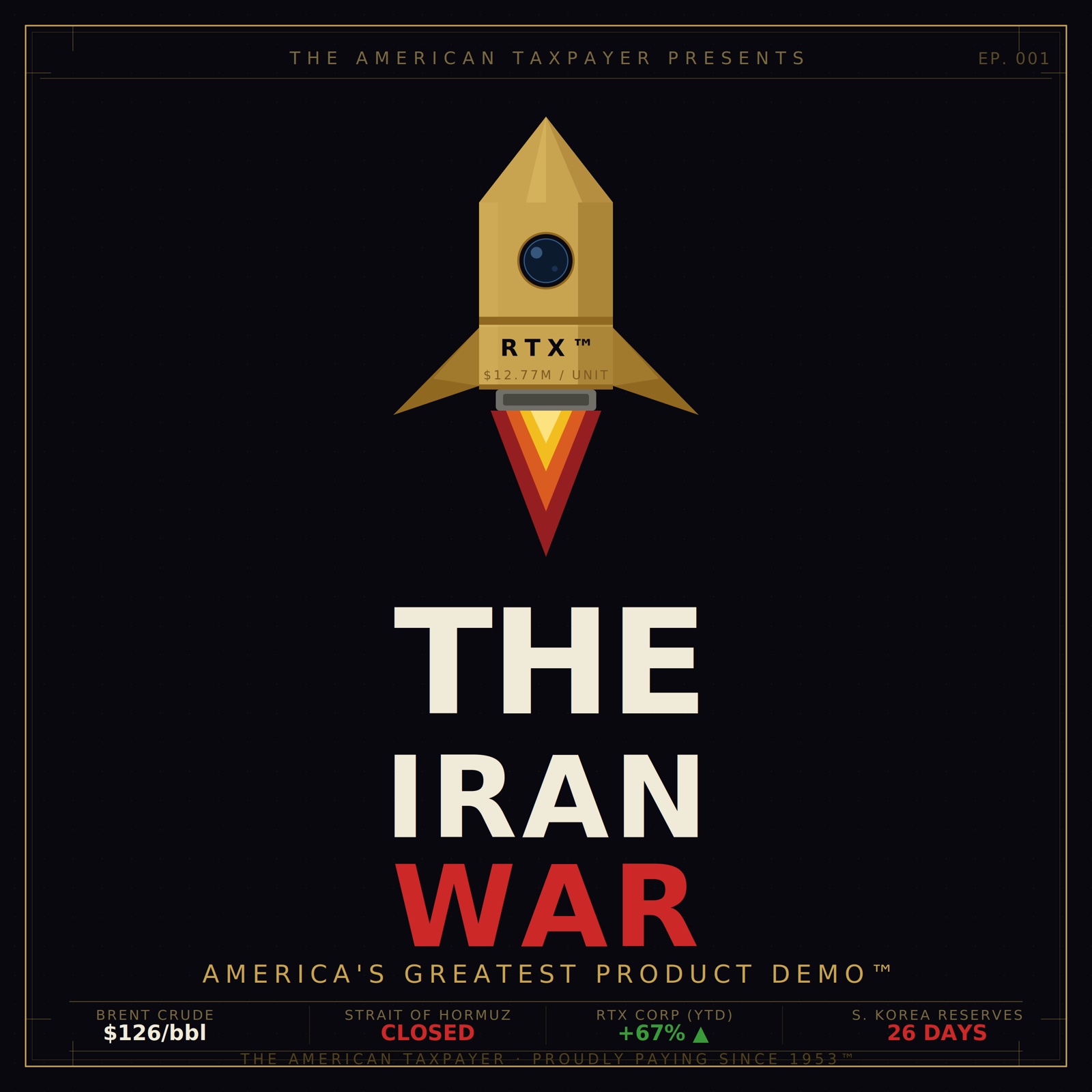
The Iran War — America's Greatest Product Demo
A seventy-year trade show, paid for by the American taxpayer.
From the 1953 CIA coup that ousted a democratically elected prime minister to the February 2026 strikes that killed the Supreme Leader, every chapter of the Iran story has ended with defense contracts. We trace the seventy-year arc — Operation Ajax to Operation Midnight Hammer — and ask: if this is a product demo, who's actually the customer?
Loading tally…
Cold open
Alright. So. We're at war with Iran.
Or — depending on which news network you watch — we're not at war with Iran, we're conducting "precision kinetic operations in support of regional stability." Which is Pentagon-speak for: we're bombing people. But we're doing it thoughtfully. With PowerPoints.
Now, I know what you're thinking. You're thinking, "Finally, someone's going to explain this to me." And I will. But first, I need you to understand something. This war — this beautiful, horrifying, multi-trillion-dollar catastrophe — is not really a war.
It's a product demo. It's the world's most expensive, most lethal trade show. And the guys with the booth? They are crushing it.
The guys with the booth
I'm talking, of course, about the defense contractors. RTX — which you might know by its old name, Raytheon. Lockheed Martin. Boeing. Northrop Grumman. These are not companies that want peace. Peace is a terrible business model. Peace is like selling umbrellas in a drought.
But war? War is a subscription service.
And the numbers don't lie. The day the war started — the very first day of trading after February 28th:
- RTX stock jumped 4.7%
- Lockheed went up 3.4%
- Northrop Grumman popped 6%
- The iShares U.S. Aerospace and Defense ETF is up 66% in the last year
- RTX stock has more than doubled since 2023
Since 2023! While the rest of your portfolio was sweating through a rate hike cycle, the defense sector was printing money.
And here's the detail that should be framed and hung in every congressional office in America:
Lockheed Martin received more in government contracts last year than the entire budget of the State Department.
The entire department of diplomacy. We spend less trying to prevent wars than we spend building weapons for the ones we're already in. Let that sit with you.
1953 — it always starts with oil
Before we get into the present disaster, let's do what nobody in cable news ever does. Let's go back. Way back. Because this story doesn't start with a missile strike. It starts with oil. It always starts with oil.
The year is 1953. Iran has a democratically elected Prime Minister. His name is Mohammad Mosaddegh. And Mosaddegh had this wild, radical, almost insane idea. He thought Iranian oil should belong to... Iran.
I know. Crazy. Revolutionary. Practically communist, if you squint hard enough and you work for British Petroleum — which, fun fact, is exactly who was furious about this.
See, Britain had been extracting Iranian oil for decades and giving Iran somewhere between "a little" and "almost nothing" in return. Standard colonial operating procedure. Mosaddegh looked at this arrangement and said, "No thank you," and nationalized the oil industry. The British lost their minds. They went running to the Americans. And the Americans, in their infinite Cold War wisdom, decided this man — this democratically elected man — was a communist threat that needed to be removed.
So the CIA cooked up Operation Ajax. And they overthrew him. A democratically elected leader. Gone. Just like that. Replaced with the Shah — Mohammad Reza Pahlavi — a man so enthusiastic about his own power that he created a secret police called SAVAK, which operated with all the charm and restraint you'd expect from a secret police force propped up by the CIA. Torture, disappearances, surveillance — the greatest hits of authoritarian governance, brought to you in part by the American taxpayer.
Here's the part where you might be expecting me to editorialize. But I don't need to. These are just the facts. Documented. Declassified. The CIA has admitted this happened. We knew the Shah was brutal. We funded it anyway.
Because oil. Because Cold War. Because the logic of empire doesn't leave a lot of room for "but is this the right thing to do."
1979 — what happens when you squeeze a population for 26 years
Fast forward to 1979. Twenty-six years of the Shah. Twenty-six years of repression. And what happens when you squeeze a population for a quarter century?
They explode.
The Iranian Revolution. Ayatollah Khomeini comes back from exile in Paris — because of course the revolution was organized partly from Paris; history loves irony — and the Shah flees. A theocratic republic is born. And immediately, immediately, the relationship between Iran and the United States becomes what diplomats call "complicated" and what normal people call "a complete catastrophe."
November 4th, 1979. Iranian students storm the U.S. Embassy in Tehran. Sixty-six Americans taken hostage. Held for 444 days.
Four hundred and forty-four days.
Jimmy Carter's presidency basically died in that embassy compound. He tried a rescue mission — Operation Eagle Claw — which failed in the Iranian desert when helicopters broke down. One of those helicopters collided with a transport aircraft. Eight American servicemen died. The mission was aborted. It was a debacle so complete, so total, that it's taught in military schools as an example of how not to do things.
The hostages? Released on January 20th, 1981 — the exact day Ronald Reagan was inaugurated. You can make of that timing whatever you want. Historians certainly have.
The line that has now been crossed
Here is where I need to correct something — something I might have told you before, something that used to be true.
For decades, every American president had Iran on their desk as the defining crisis of their administration. And the remarkable thing — the genuinely astonishing thing — was that none of them had actually launched a full military campaign against Iran. Not Reagan. Not Bush. Not Clinton. Not Obama. Trump got closest in 2019 when he ordered a strike, then called it off ten minutes before impact after asking how many Iranians would die.
The answer was 150. He said that was too many.
That era is now officially over.
June 2025 — the Twelve-Day War
In June 2025, the Twelve-Day War. Israel launched a surprise military offensive against Iran. The US initially said it wasn't involved.
Then, on June 22nd, 2025, US forces launched Operation Midnight Hammer:
- 4,000 military personnel
- 7 B-2 stealth bombers
- 12 massive bunker-buster bombs dropped on Fordow alone
- Simultaneous strikes on the nuclear facilities at Fordow, Natanz, and Isfahan
The first time the US had ever struck Iranian soil.
February 28th, 2026 — they killed the Ayatollah
And then — just when you thought maybe it was over — February 28th, 2026. The US and Israel launched a second, far larger wave of strikes. This time targeting not just nuclear sites, but Iranian military leadership, government sites, and — they assassinated the Supreme Leader.
Ali Khamenei is dead. They killed the Ayatollah. The man who had run Iran since 1989. Gone.
Trump's response? He posted on Truth Social: "We now have complete and total control of the skies over Iran." And called for Iran's "unconditional surrender."
Unconditional surrender. To a country of 90 million people. With mountains. And a military that has been preparing for American invasion for four decades.
Sure. That sounds like it's going great.
The bill
So here is the bill. Let's talk about what we're actually paying for.
The Strait of Hormuz. Twenty-one miles wide at its narrowest point. And through those twenty-one miles used to flow approximately 20% of the world's oil supply — roughly 17 million barrels a day.
Used to.
Iran closed it. The Islamic Revolutionary Guard Corps announced that any vessel going "to and from" the ports of the US, Israel, and their allies is prohibited from passing.
- 21 confirmed attacks on merchant ships
- Sea mines in the strait
- Over 2,000 ships stranded in the Persian Gulf
- 20,000 mariners trapped
Just... stuck out there.
Brent crude — sitting at roughly $72 a barrel before this started — hit $126 a barrel at its peak. The IEA — the International Energy Agency, the people whose literal job is to track this stuff — called it the "greatest global energy security challenge in history."
Not the greatest in recent history. Not the greatest since the 70s. In history. Period.
And analysts are now openly — openly — discussing oil hitting $200 a barrel if the closure continues. Two hundred dollars.
- The Dallas Fed is modeling scenarios where global GDP growth drops nearly 3 percentage points in a single quarter.
- The ECB has postponed rate cuts, raised its inflation forecast, and economists are warning of stagflation.
- UK inflation is expected to breach 5%.
- The Philippines declared a state of emergency.
- Myanmar is rationing private vehicle use to alternate days.
- Vietnam, Bangladesh, Pakistan — all in crisis.
Case study: South Korea
Let me tell you about South Korea, because South Korea is the perfect encapsulation of how this kind of thing ripples out to people who have absolutely nothing to do with any of it.
South Korea imports 70% of its crude oil through the Strait of Hormuz. As of right now:
| Indicator | Status |
|---|---|
| Strategic petroleum reserves | 26 days of consumption |
| Major airlines in emergency status | Korean Air, Asiana, Air Busan, Tway |
| KOSPI stock index | Worst session in its 43-year history |
| Korean won | 17-year low |
| Vessels stranded in Persian Gulf | 26 Korean-flagged ships |
| Diplomacy | Public shouting match with Israel |
| Emergency supply talks | Kazakhstan, Saudi Arabia, UAE |
That is the world's 10th largest economy. A semiconductor giant. A global cultural force. Operating on 26 days of gas because of decisions made in Jerusalem, Washington, and Tehran.
And here's the kicker — South Korea is also one of the world's biggest exporters of refined fuel. Other countries in Asia depend on South Korean refining capacity. So when South Korea limits its exports to protect its own supply, that shortage cascades.
Japan. Vietnam. Australia. The entire region feels it.
Oh, and there's a helium shortage now too. 64% of South Korea's helium — which you need for semiconductor manufacturing — came from Qatar. Qatar's massive LNG plant got hit by Iranian missiles. The plant's owner says it could take up to five years to repair. So now there's a helium shortage threatening the global semiconductor supply chain. Which will affect everything that has a chip in it.
Which is everything.
You're welcome.
Who pushed for this
Israel wanted this war. I'm not editorializing. This is the stated, documented, publicly argued position of the Israeli government. Benjamin Netanyahu has been making the case for a military strike on Iran for literally decades.
Iran funds Hezbollah on Israel's northern border. Iran funded Hamas. Iran has said — openly said — things about Israel that are not ambiguous.
Here's the timeline:
- June 2025 — US and Iran are in the middle of nuclear negotiations. Actual diplomacy. Actual talks. Israel launches its Twelve-Day War. Surprises everyone. Strikes ~100 targets, kills senior Iranian military figures and nuclear scientists.
- The US initially denies involvement, then joins with strikes on the nuclear sites.
- February 2026 — negotiations are reportedly progressing again. The Omani foreign minister says there is "significant progress," that Iran is willing to make concessions. Trump says he is "not thrilled" with the talks.
- February 28, 2026 — the strikes begin. During negotiations.
A CNN poll taken after the February strikes found 56% of Americans disapproved of the decision. A majority. Members of both parties in Congress said Trump violated the Constitution by not seeking authorization.
Even some Republicans. Even Rand Paul. Even Tucker Carlson criticized it.
When Tucker Carlson is the voice of restraint, you should probably take a breath.
The scoreboard
So the war started. And now we have:
- A dead Supreme Leader
- A closed Strait of Hormuz
- Oil at $126 a barrel
- South Korea running on fumes
- A global fuel crisis the IEA is calling the worst in history
- Defense contractors sitting on $200 billion in projected windfalls
RTX — formerly Raytheon — has a $268 billion order backlog. Two hundred and sixty-eight billion dollars. They've already been told to increase Tomahawk cruise missile production. They increased munitions output 20% in 2025, and they're accelerating again in 2026.
The Wall Street consensus on RTX right now? 15 "Strong Buy" ratings. 1 "Strong Sell." The analysts know which way this is going.
And in a move that could only happen in America, less than a week after the February strikes, the CEOs of RTX, Lockheed Martin, Boeing, Northrop Grumman, BAE Systems, and others met with President Trump at the White House to discuss "the nation's needs."
The nation's needs. Very subtle.
Lockheed, by the way, had already signed a deal in January — before the February strikes — to quadruple THAAD interceptor production:
- From 96 to 400 per year
- Each interceptor costs $12.77 million
They knew. Or at minimum, they had a very good guess.
The close
So let's come back to the product demo.
Here is what is being sold to you. To me. To every American who pays taxes and buys gas and has a 401k that's currently doing something deeply unpleasant:
We are being sold security. The idea that this war makes us safer. That striking Iranian targets, killing the Ayatollah, supporting our ally Israel — that this is a cost worth bearing. That it is an investment in regional stability.
Notice who is making that argument with the most enthusiasm. Notice who is on television, night after night, explaining why this war is necessary, why it is winnable. Check their donors. Check their board seats. Check where they go after they leave government. Check the revolving door between the Pentagon and the defense industry, which spins so fast it could generate electricity.
It does not. But it could.
The CIA overthrew a democracy in 1953. Installed a brutal dictator to protect oil interests. That dictator was overthrown. The revolution birthed a theocracy hostile to us ever since. Decades of proxy conflict. A hostage crisis. Bombings. Sanctions. Near-wars. A twelve-day war.
And now, finally, a real war — with a closed strait, a global fuel crisis, a dead Supreme Leader, and oil at $126 a barrel.
All of it, every chapter, has been accompanied by defense contracts. By arms sales. By the logic that the solution to the last military intervention is the next military intervention.
And through it all — from Operation Ajax in 1953 to Operation Midnight Hammer in 2025 — one thing has remained constant.
Somebody is getting paid.
That somebody is not you.
You're the customer. You always have been.
You just didn't know you were buying.
Full source list and charts in the dead drop newsletter.